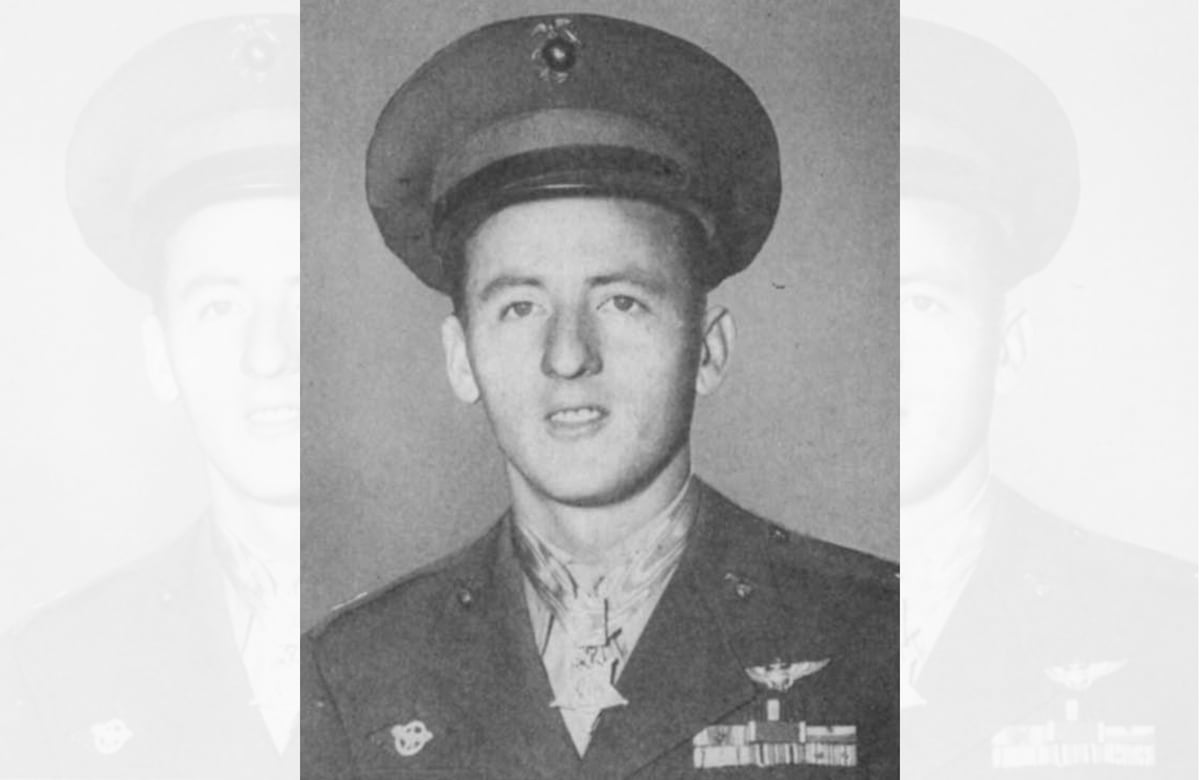
Jefferson Joseph DeBlanc, a Marine pilot during World War II, earned the prestigious title of ace while bravely serving in the Pacific Theater. Born on February 15, 1921, in Lockport, Louisiana, DeBlanc’s journey began when he enlisted in the U.S. Marines, avoiding what he described as “the Yankee army.” After completing his flight training with the U.S. Navy in July 1941, he transferred to the Marine Corps, where he was commissioned as a second lieutenant on April 3, 1942.
DeBlanc joined Marine Fighter Squadron VMF-112 just days before it was deployed overseas. He quickly gained experience flying the Grumman F4F-4 Wildcat. His first engagement with enemy forces occurred on November 12, 1942. During a fierce aerial battle over Guadalcanal, DeBlanc and his squadron faced a wave of Mitsubishi G4M1 bombers attacking American shipping.
DeBlanc described the encounter as “a fighter pilot’s dream,” albeit overshadowed by intense antiaircraft fire. He successfully downed his first target, marking the start of an illustrious combat career.
Rapid Ascent to Ace Status
On December 18, 1942, DeBlanc scored another victory when he shot down a Mitsubishi F1M2 during an encounter with a Douglas SBD-3 Dauntless dive bomber. His skills were further tested on January 29, 1943, when engine trouble forced him to parachute from his Wildcat. Rescued by the destroyer USS Jenkins (DD-447), he soon returned to action.
Two days later, DeBlanc led a team of eight Wildcats against enemy fighters while supporting a bombing mission near Kolombangara. He successfully downed multiple enemy aircraft, showcasing exceptional flying skills. In a tense moment, he performed a Thach weave maneuver with Staff Sergeant James A. Feliton, which allowed them to engage the enemy more effectively. Despite being wounded during the encounter, DeBlanc managed to bail out and was rescued by local coastwatchers.
Incredibly, his five aerial victories on that day earned him recognition as the first Marine to achieve quintuple victory in a single mission. His squadron commander, Major Paul J. Fontana, recommended him for the Navy Cross, which was later upgraded to the Medal of Honor. DeBlanc received the award from President Harry Truman on December 6, 1946.
A Legacy Beyond the Skies
After the war, DeBlanc continued his service, eventually being promoted to captain on May 31, 1943. He returned to the United States in June as a tactics instructor and later served with VMF-422 in the Marshall Islands in 1944. His combat experience culminated in Okinawa, where he scored his final aerial victory.
Beyond his military career, DeBlanc was dedicated to education. He earned four degrees, including a Doctorate of Education from McNeese State University. He taught mathematics and physics at various institutions in the United States and Europe. DeBlanc maintained a reserve commission until his retirement as a colonel from the New Orleans Marine Air Group in 1972.
DeBlanc passed away on November 7, 2007, in Saint Martinville, Louisiana. His life story, documented in his memoir “The Guadalcanal Air War,” showcases not only his military achievements but also his commitment to education and family heritage. Through his experiences, DeBlanc remains a significant figure in both military history and the narrative of American aviation.