Residents of Palestinian-majority towns in Israel are demanding government action against rampant organized crime that threatens their safety and livelihoods. The urgency of their plea escalated after a shopkeeper, Ali Zbeedat, from Sakhnin, decided to close his businesses following a violent threat against him. This incident has ignited protests across the country, uniting both Palestinian and Jewish citizens against the escalating violence that has gripped these communities.
On a January morning, Zbeedat received a chilling message stating, “We know where you go and where you walk. We will kill you if you don’t finish what you’re supposed to.” His businesses had already been attacked multiple times, with the most recent incident involving a hail of bullets fired at one of his stores. The fear of further violence prompted him to shut down operations indefinitely, a move that resonated with many in the community.
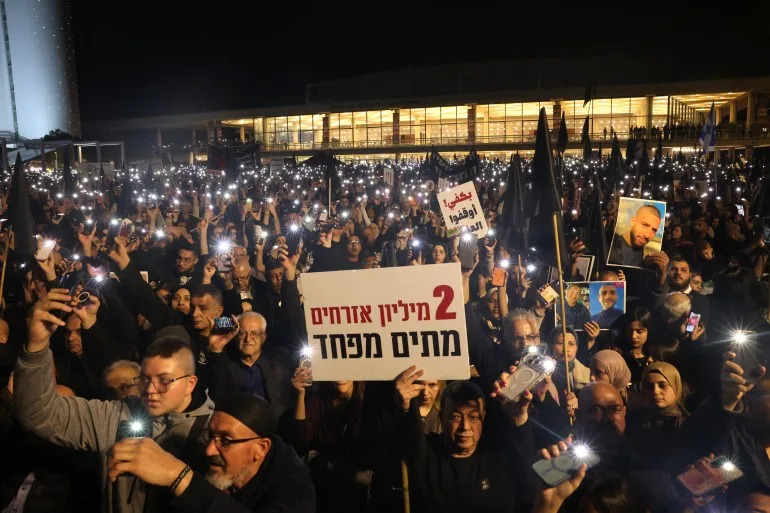
The closure of his businesses sparked a wave of protests in Sakhnin, which spread to larger cities like Tel Aviv, where tens of thousands demonstrated against organized crime. Commentators described the scale of public sentiment as “historic,” with participants calling for an end to the violence that has become a distressing reality in Palestinian towns.
Aida Touma-Suleiman, a Palestinian member of the Israeli parliament representing the left-wing Hadash-Ta’al faction, emphasized the dire situation, stating, “In 2025, 252 Palestinians were murdered in Israel, but that doesn’t tell you everything.” She highlighted the pervasive fear and anxiety that have become part of daily life for many, where the threat of violence forces individuals to pay exorbitant fees for protection. “It took one very courageous man in Sakhnin to light the spark,” she noted.
Systematic Neglect and Rising Crime
Palestinian citizens in Israel, who represent approximately 21 percent of the population, are often marginalized and live in isolation from the wider Israeli society. This separation has led to a significant lack of government support. Observers like Hassan Jabareen, founder of the Arab rights organization Adalah, assert that the state’s absence creates a vacuum that organized crime exploits.
The socioeconomic conditions in these communities are dire. According to Israel’s National Insurance Institute, about 38 percent of Palestinian households live below the poverty line, with many struggling to make ends meet. Unemployment rates are high, exacerbated by restrictions following the outbreak of conflict in Gaza in 2023. The data from 2024 indicates that only 54 percent of Palestinian men and 36 percent of women are employed, further contributing to the environment that facilitates crime.
Touma-Suleiman described how the absence of police stations in Palestinian towns has allowed criminal networks to flourish. Many individuals who previously sought opportunities in Israel return to their communities with knowledge of illicit operations, creating organized crime networks that operate with relative impunity. She noted, “A lot of those families are now running criminal organizations, even the police say those families are under the protection of the Shabak,” Israel’s internal security agency.
Public Response and Government Inaction
The scale of organized crime has reached alarming levels, resembling operations similar to the Italian mafia. Gangs have established control over local businesses, monopolizing commercial activities in Palestinian areas. The lack of effective law enforcement, particularly under the leadership of far-right Minister of National Security Itamar Ben-Gvir, has led to a climate of fear.
As protests continued, demonstrators in Tel Aviv carried banners with messages like “Enough violence and murder” and “Arab Lives Matter.” These protests have not gone unnoticed, even by Israeli officials. President Isaac Herzog acknowledged the need to address the violence, which has garnered attention from various sectors of society.
In light of the growing unrest, Prime Minister Benjamin Netanyahu is reportedly considering appointing Ben-Gvir to lead a task force to combat organized crime in Palestinian communities. Yet, many remain skeptical about the sincerity and effectiveness of such measures, given the historical neglect of these areas.
Jabareen poignantly contrasted the childhood experiences of Palestinian and Israeli Jewish children. “One will have safety… The other boy will not be able to sleep for the sound of guns. He will worry about being shot accidentally on his way to school,” he explained, highlighting the stark realities faced by children in these communities.
As the situation unfolds, the voices of Palestinian citizens continue to demand recognition and action from the Israeli government. The protests signal a united front against organized crime, reflecting a broader desire for safety, justice, and dignity in their lives.