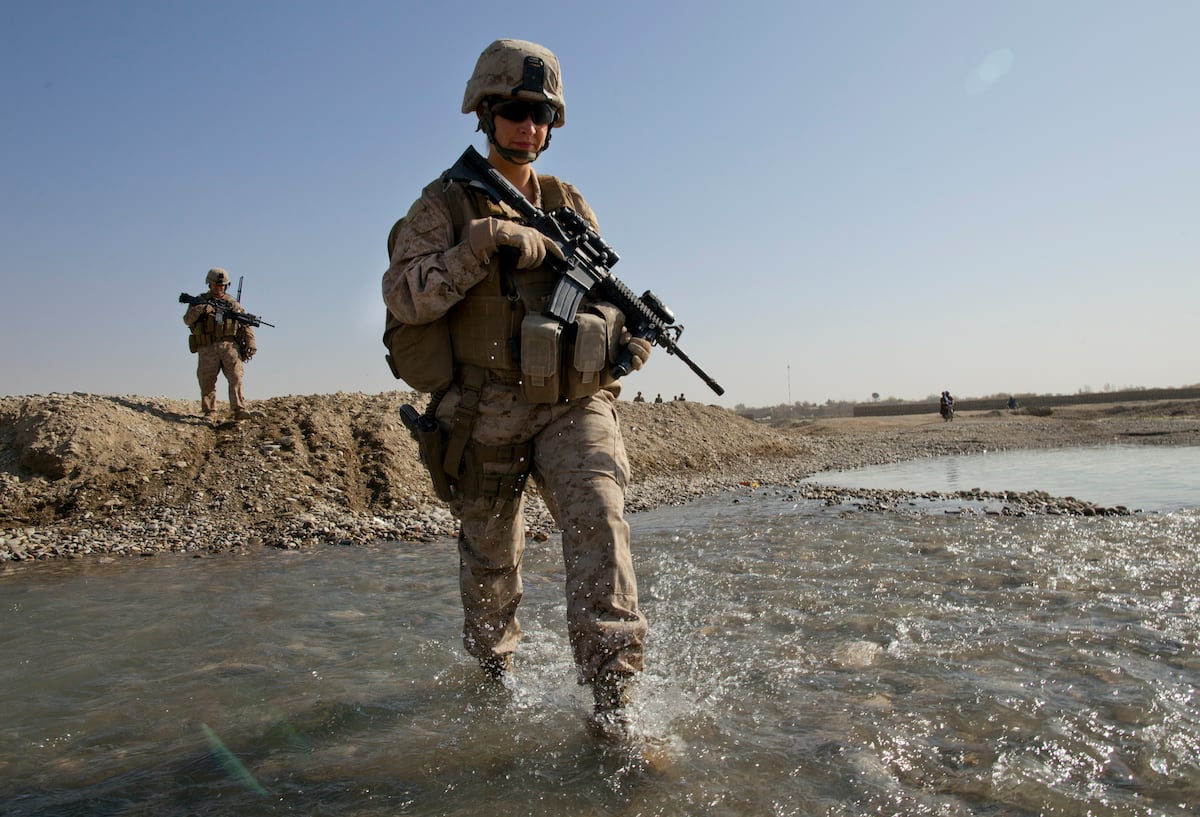
The Pentagon has initiated a formal review of the effectiveness of women in combat roles, raising concerns among female service members who believe this review undermines their achievements. This decision comes more than a decade after the U.S. Army opened Ranger School and all combat positions to women, a significant shift in military policy that was celebrated by many as a step toward equality.
In early 2025, the U.S. Army reported that at least 154 women have successfully earned the prestigious Ranger tab, a testament to their resilience and capability. Ranger School, known for its intense physical and mental challenges, has historically been exclusive to men until the Department of Defense changed the rules in 2015. The rigorous training includes demanding tasks such as a swim test in full uniform, a five-mile run to be completed in under 40 minutes, and a 12-mile foot march carrying a 35-pound rucksack.
The Pentagon’s review, which aims to assess whether the military can meet its rigorous operational demands, has reignited a discussion that many female service members believed had been settled. In a statement to Military Times, Defense Secretary Pete Hegseth emphasized that he would not compromise standards to meet quotas or any ideological agenda, asserting that maintaining high standards is essential for military effectiveness.
Critics, however, argue that women have already demonstrated their competence in elite combat roles. Current data from the Women in the Service Coalition shows that there are 4,594 female soldiers deployed in the Army’s conventional combat units. The Pentagon declined to comment on these numbers, which underscores the contentious nature of the review.
Many women within the military, including Sue Fulton, executive director of the Women in the Service Coalition, express skepticism about the review’s intentions. Fulton expressed concern that the study may aim to reinforce a notion that women do not belong in the infantry. “The only reason to conduct a new study is if you want a different outcome,” she stated, suggesting that the review could be manipulated to yield a predetermined conclusion.
Hegseth’s previous comments have further fueled these suspicions, as he openly criticized the inclusion of women in frontline combat roles before assuming his current position. In a November 2024 podcast, he cited a Marine Corps report indicating that all-male units had outperformed mixed-gender units during a 2015 infantry integration test. Despite his earlier stance, Hegseth later softened his position during his confirmation hearing, stating that “if we have the right standard and women meet that standard, roger, let’s go.”
Concerns intensified following Hegseth’s remarks in September 2025, where he stated that “every requirement” for combat troops would revert to “the highest male standard only.” This declaration prompted strong reactions from female veterans who have successfully completed Ranger School and served in combat. One former Ranger School graduate, who requested anonymity, described the review as a “slap in the face” to women who have proven their abilities in combat roles. She emphasized that the standards were never lowered for women, asserting, “We earned our spots.”
Another veteran, Olivia, a field artillery officer with multiple deployments, shared her perspective on the realities of combat. “Combat is an equalizer,” she noted, highlighting that when faced with life-threatening situations, gender divisions become irrelevant. “It matters that we are all a part of the same fighting force and we all have the same goal in mind,” she added, reiterating that in combat, performance is the only standard that counts.
The introduction of gender-neutral physical tests by the Army, following the opening of all combat roles to women, aimed to ensure fairness in evaluating candidates. Hegseth’s expansion of this framework in 2025 to include all combat arms positions further reflected a commitment to maintaining rigorous standards, yet the current review calls into question the military’s dedication to these principles.
As this debate unfolds, the implications for female service members and the broader military culture remain significant. The outcome of the Pentagon’s review could have lasting effects on the future of women in combat roles, and many are watching closely to see how this will shape the landscape of the U.S. military.