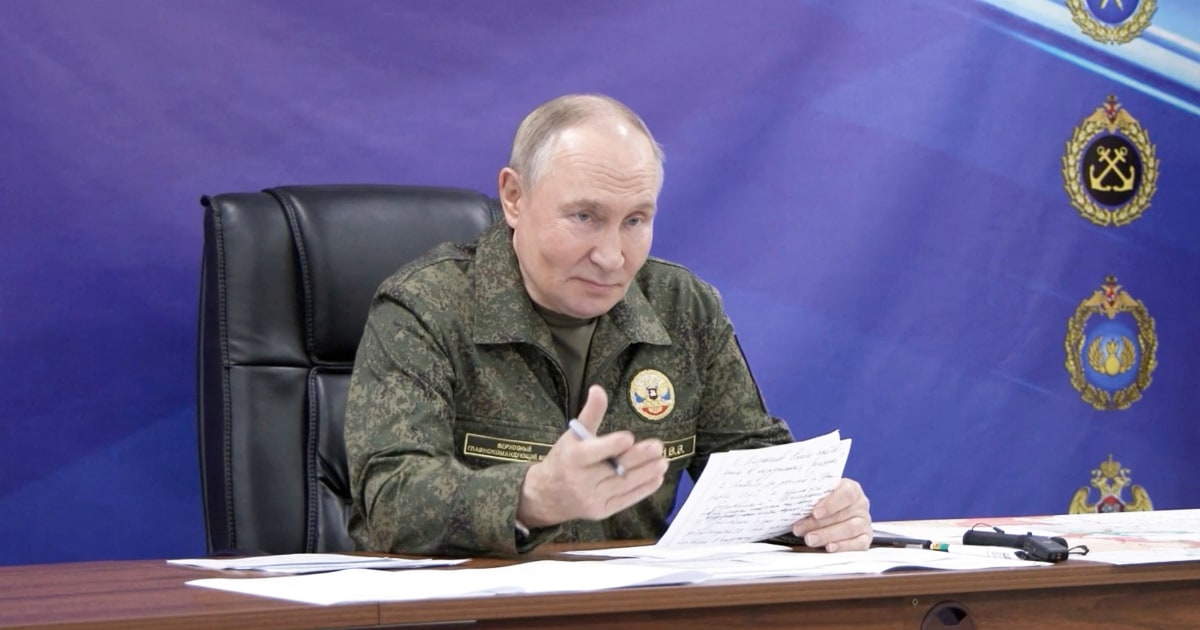
Russia has announced the successful test of a new experimental weapon, the Burevestnik, a nuclear-powered cruise missile that reportedly possesses an unlimited range. This missile is designed to evade missile defenses and has the capability to deliver nuclear payloads anywhere on Earth. During a statement on March 24, 2024, President Vladimir Putin characterized the Burevestnik as a “unique weapon” that no other nation currently possesses. The announcement has sparked international concern, particularly from Western leaders.
In response to the test, former U.S. President Donald Trump criticized Russia for conducting missile tests while ongoing peace talks regarding Ukraine remain unresolved. He labeled the tests “inappropriate,” emphasizing the need for dialogue instead of military demonstrations. Trump remarked, “We have a nuclear submarine, the greatest in the world, right off their shores,” adding that the Burevestnik’s long-range capabilities were unnecessary given existing military assets.
The test was formally disclosed by Putin and Gen. Valery Gerasimov, the chief of Russia’s general staff, who reported that the missile had flown for 15 hours and covered 8,700 miles during its recent test. Gerasimov praised the missile’s “assured accuracy against highly protected targets at any range,” citing its ability to evade both missile-defense and air-defense systems. Despite these claims, experts remain skeptical about the missile’s actual military utility.
Concerns Regarding Safety and Utility
Critics have raised significant safety concerns regarding the Burevestnik, particularly related to its nuclear reactor, which powers the missile. Pavel Podvig, a senior researcher at the United Nations Institute for Disarmament Research, noted that the missile’s development is primarily political rather than practical. He stated, “The main reason that no one else has tried to build something like this is that it doesn’t really have any use.” Podvig suggested that the Kremlin’s motive behind the Burevestnik is to showcase a technological advancement that distinguishes Russia from other nations.
The Burevestnik is not a new concept; it was first introduced by Putin in March 2018. The missile utilizes a miniature nuclear reactor to heat air to extreme temperatures, enabling it to sustain flight for extended periods. Both the United States and the Soviet Union explored similar technologies during the Cold War but ultimately abandoned them due to safety concerns and feasibility issues. The dangers were highlighted in 2019 when a failed test of a similar system resulted in an offshore explosion in the Russian Arctic that killed five scientists and caused a spike in radiation levels in a nearby city.
Norwegian officials have confirmed that the latest test was conducted from an archipelago in the Barents Sea. Vice Admiral Nils Andreas Stensoenes, head of Norway’s Intelligence Service, stated, “We can confirm that Russia has conducted a new test launch of the long-range cruise missile Skyfall (Burevestnik) on Novaya Zemlya.”
Political Implications and Reactions
The Burevestnik is considered a second-strike weapon, intended to be part of Russia’s nuclear deterrent strategy. However, experts believe that a nuclear attack on Russian military sites would inevitably target the missile’s launch platforms. The test is seen by some analysts as a political maneuver responding to recent U.S. missile defense plans and sanctions from the European Union.
Putin’s spokesperson, Dmitry Peskov, reinforced the notion that Russia prioritizes its national interests in the face of perceived threats. “Ensuring security is a vital issue for Russia, especially given the militaristic sentiment we are currently hearing primarily from Europeans,” Peskov stated during a news briefing. He emphasized Russia’s openness to dialogue with the United States while asserting the importance of national security.
In contrast, some observers, such as Fabian Hoffmann from the Oslo Nuclear Project, view the missile as a flawed investment. Hoffmann commented, “I celebrate every ruble Russia invests in this useless and unnecessary missile,” reflecting a broader skepticism about the missile’s strategic value.
As the geopolitical landscape continues to evolve, the implications of the Burevestnik test will require careful monitoring. The international community remains watchful of Russia’s military advancements and their potential impact on global security dynamics.