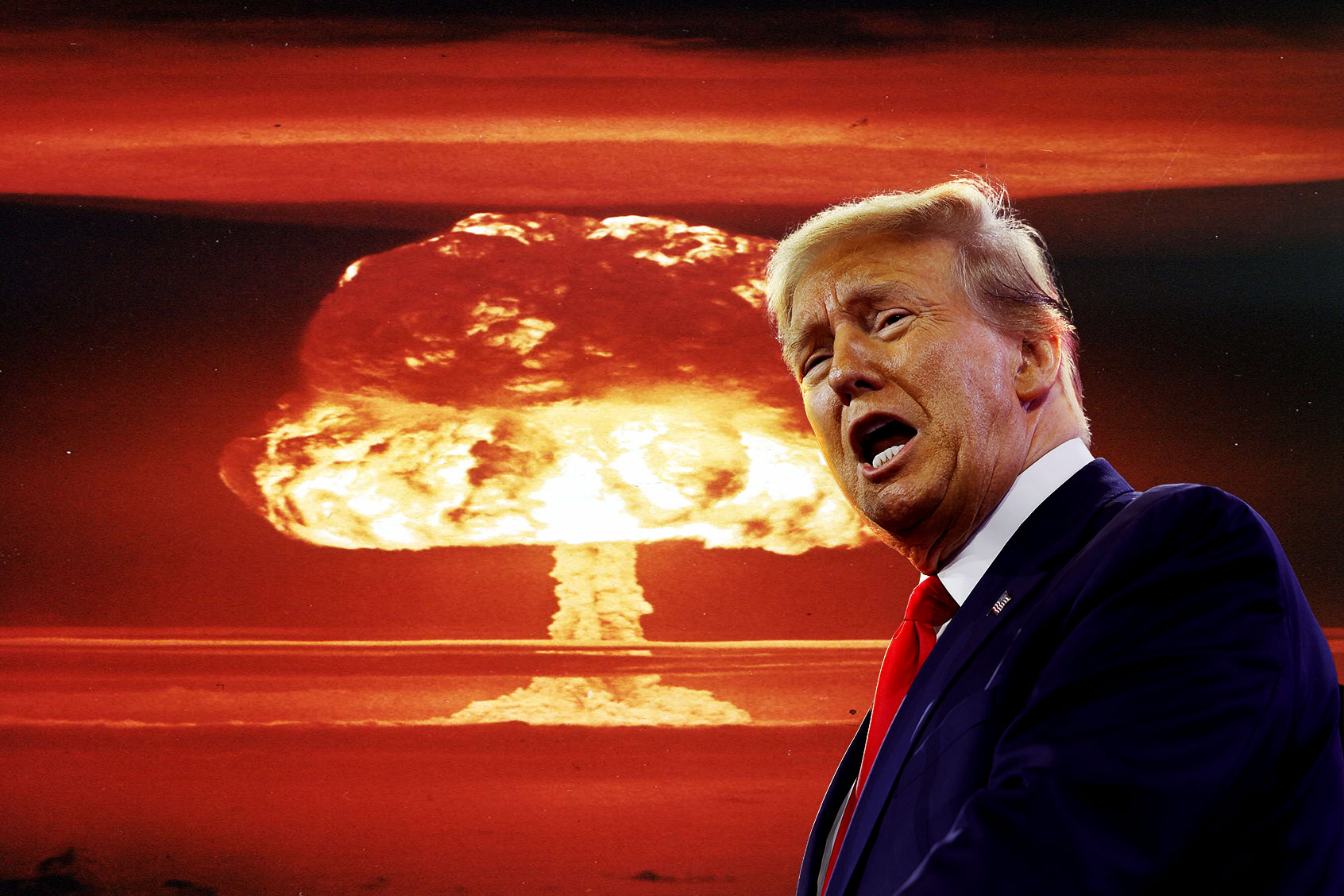
President Donald Trump announced plans to resume nuclear testing in the United States, ending a moratorium that has lasted nearly three decades. His declaration came during a return trip from Asia, where he expressed concern about the nuclear capabilities of other nations. Trump’s reasoning appears to stem from a misinterpretation of international developments, particularly regarding North Korea and Russia, where recent military activities have raised tensions.
The timing of Trump’s announcement raises questions, especially as it coincides with his travels. One notable cultural reference is Kathryn Bigelow‘s latest film, “House Full of Dynamite,” which explores themes of nuclear conflict. Although it remains unclear whether Trump’s comments were influenced by the film, it has sparked speculation among observers.
Currently, North Korea is the only nation known to have conducted nuclear tests in recent years, as Kim Jong Un continues to develop his country’s nuclear arsenal. No other nuclear-armed states have engaged in testing since the 1990s. This context makes Trump’s assertion that other countries are actively testing their nuclear weapons misleading.
Trump has previously claimed expertise on nuclear issues, citing his uncle, Dr. John G. Trump, a physicist who taught at the Massachusetts Institute of Technology. He has often referenced their shared “good genes” as evidence of his understanding of nuclear power. However, many critics argue that his grasp of the subject remains superficial.
In a 1984 interview with the Washington Post, Trump expressed a desire to negotiate arms agreements with the Soviet Union but notably refrained from detailing his plans. His belief that he could quickly learn about missiles has been documented in various interviews over the years, including a Playboy interview where he remarked, “I’ve always thought about the issue of nuclear war; it’s a very important element in my thought process.”
Concerns about Trump’s understanding of nuclear issues deepened during his presidency. Reports indicated that he frequently questioned why the U.S. could not use nuclear weapons and expressed a desire to increase the arsenal, seemingly unaware of longstanding arms control agreements. For instance, during a Pentagon briefing, Trump reportedly did not recognize the significance of the U.S. reducing its nuclear warheads from over 30,000 to approximately 3,800.
As Trump moves forward with his proposal, critics warn about the implications of renewed nuclear testing. Defense Secretary Pete Hegseth and other officials within the Pentagon have suggested a more aggressive nuclear posture. Elbridge A. Colby, the current Undersecretary of Defense for Policy, advocated for policies allowing nuclear responses to cyberattacks during Trump’s first term.
The U.S. possesses advanced monitoring systems that do not require physical testing of nuclear devices. Experts argue that resuming tests could unnecessarily escalate international tensions, echoing Cold War-era strategies that often led to widespread anxiety and environmental harm.
In light of these developments, the potential for Trump to make decisions regarding nuclear arms raises significant concerns among national security experts. The administration’s reliance on a close circle of advisors has led to fears about the implications of such a critical issue being handled without robust scrutiny.
The question remains whether Trump’s proposal will gain traction, but the prospect of resuming nuclear tests is alarming for many. As Trump continues to navigate complex global tensions, the hope is for informed decision-making that prioritizes stability over provocation.