A recent study has identified a crucial molecular mechanism that enhances our understanding of how cells communicate through extracellular vesicles (EVs). These small particles have significant therapeutic potential, and the findings, published on November 28, 2025, in the Journal of Extracellular Vesicles, highlight the role of the Commander protein complex in this process.
Led by Professor Albert Lu from the Faculty of Medicine and Health Sciences at the University of Barcelona, along with María Yáñez-Mó from the Severo Ochoa Center for Molecular Biology, the study reveals that the Commander complex, previously recognized for its role in membrane recycling, also coordinates how vesicles enter cells and their destinations within. This discovery is significant for developing new therapies and diagnostic tools.
Professor Lu emphasized the importance of this research, stating, “Understanding how receptor cells capture and process extracellular vesicles is essential to understanding how our body communicates at the molecular level.” He further noted that this knowledge is key to harnessing the therapeutic potential of EVs, as their efficacy relies on their ability to target the appropriate cells.
Innovative Methodology Using CRISPR Technology
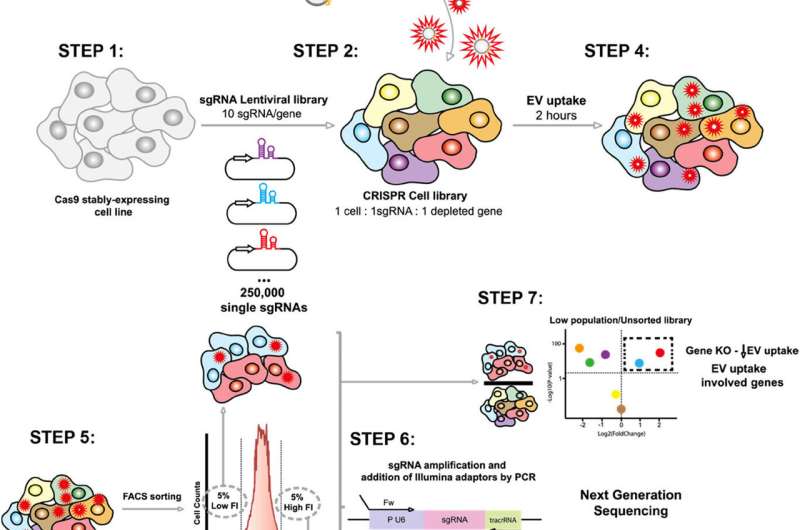
The research team employed an innovative methodology based on CRISPR-Cas9 technology, which allows for the deactivation of each of the over 20,000 human genes individually. This approach enabled the researchers to systematically analyze the role of each gene in the uptake and internalization of EVs.
The researchers genetically modified cells so that each group had a different gene deactivated. The cells were then exposed to EVs labeled with a fluorescent dye. Through flow cytometry, they measured how many vesicles were captured by the cells. Subsequently, fluorescence-activated cell sorting (FACS) was utilized to separate cells based on their uptake capacity, and mass sequencing helped identify the deactivated genes.
“This systematic and unbiased approach allows us to discover new regulators without relying on prior hypotheses,” explained Professor Lu.
The results revealed that the Commander endosomal recycling complex acts as a fundamental regulator of vesicle uptake. The study’s findings, based on various human cell lines, suggest that “the mechanism is conserved and potentially universal,” according to Lu, although its activity may vary depending on the cell type or physiological context.
Implications for Future Therapeutics
Understanding the mechanisms of EV communication holds significant therapeutic implications. The ability of these vesicles to cross cellular membranes and reach specific tissues positions them as potential natural vehicles for delivering drugs or therapeutic molecules.
“Understanding how their entry, intracellular trafficking, and delivery of their molecular cargo are regulated opens the door to designing EVs with controlled directionality,” said Professor Lu. This could enhance their efficacy in regenerative, oncological, or anti-inflammatory therapies.
The research team is currently investigating the role of the Commander complex in controlling the uptake and intracellular fate of EVs. They aim to determine whether this mechanism is maintained across different cell types or tissues. Furthermore, they plan to explore whether alterations in this complex are involved in disrupted cell communication in pathological contexts, such as cancer or neurodegenerative disorders.
In conclusion, the long-term goal of this research is to manipulate the pathway to modulate communication between cells, thereby improving the use of EVs as therapeutic and diagnostic tools. As Professor Lu aptly summarized, the findings pave the way for future advancements in medical science.
For further details, refer to the study by Miguel Palma‐Cobo et al, titled “Genome‐Wide CRISPR/Cas9 Screening Identifies the COMMANDER Recycling Complex as a Key Player in EV Uptake,” published in the Journal of Extracellular Vesicles (2025).