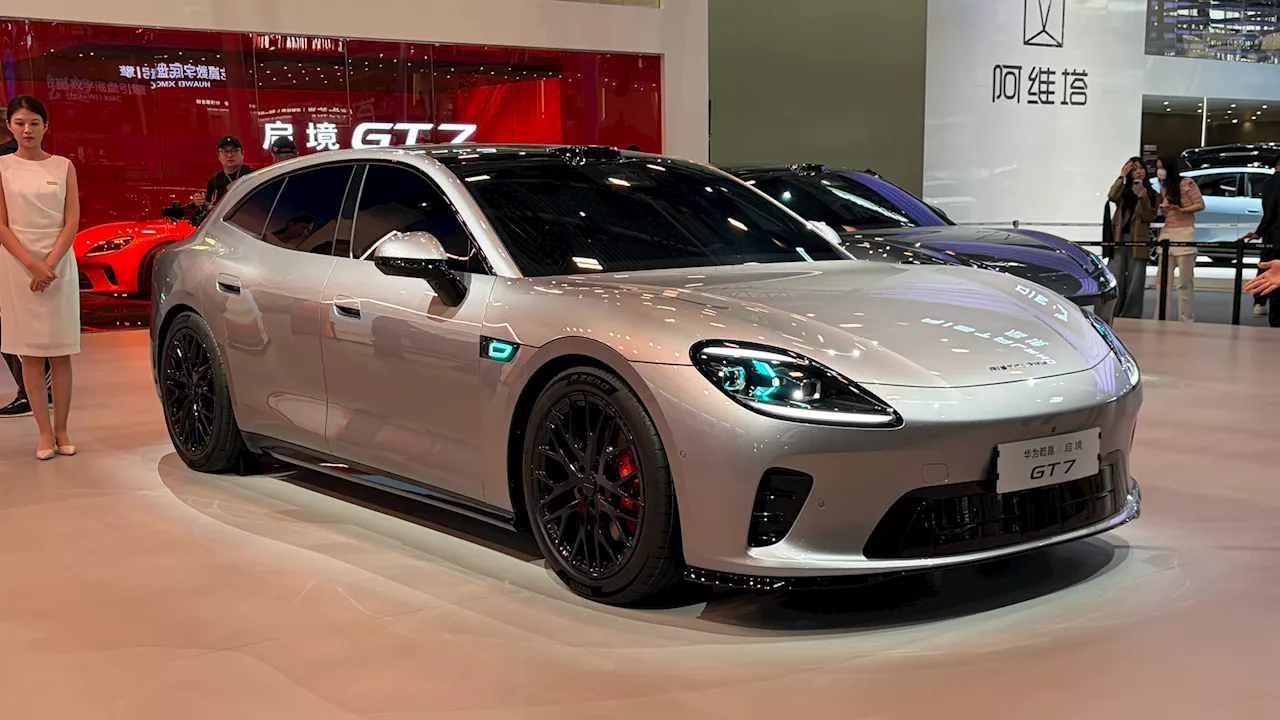
Huawei and Chinese automaker GAC have just unveiled their new electric vehicle, the Aistaland GT7, a sleek model that closely mirrors the design and size of the famed Porsche Panamera. Revealed recently at the Beijing Auto Show, this launch signals a bold move in the rapidly evolving global EV market, spotlighting China’s growing innovation in automotive technology.
The Aistaland GT7, branded as Qijing in China, matches the Panamera with near-identical dimensions: a length of 5050 mm, width of 1980 mm, and wheelbase stretching to 3000 mm. This positions it strongly alongside luxury electric sedans favored by American and global consumers. But the GT7’s resemblance to Porsche is more than skin deep.
Advanced Huawei Tech Powers the New EV
The new vehicle integrates cutting-edge technology developed by Huawei, featuring intelligent Xpixel headlights that project road warnings directly in front of the car—technology comparable to some of the most advanced systems seen in Mercedes-Benz models. Even more impressive is its high-definition Lidar system with an 896-line resolution, drastically outperforming the typical 192-line systems currently standard in the EV market. This enables the GT7 to detect objects as small as 14 cm from 122 meters away, enhancing safety and nighttime driving assistance.
Additionally, the GT7 runs on a sophisticated 800-volt electrical architecture and includes an active suspension system, promising both efficient performance and a smooth ride. It will be available in a dual-motor all-wheel-drive version, powered by batteries supplied by the renowned Chinese manufacturer CATL.
Beijing Debut and Market Focus: China First
The Aistaland GT7 is set to hit Chinese showrooms in about a month. While the company has yet to announce plans for US or international release, the EV’s debut makes waves for American EV enthusiasts and industry watchers eager to see new competition and technology innovation from Asia’s automotive powerhouses.
Reports also highlight the availability of a range extender (REX) version, which retains a gasoline engine above the front axle to generate additional electricity—a feature particularly popular in China’s transitional EV market. The range extender model caters to drivers concerned about charging infrastructure and range anxiety.
US Market Watchers Take Notice
Though Huawei faces regulatory challenges in the US telecom sector, its automotive ambitions reflect a growing investment in smart vehicle technologies and AI-driven systems. The Aistaland GT7’s combination of luxury design cues and advanced safety tech positions it as a notable competitor as the US market increasingly embraces electric sedans.
Curtis Moldrich, Digital Editor at CAR magazine, emphasized the vehicle’s impressive mix of style and technology, noting, “The GT7 brings China’s EV capabilities into sharp focus, with tech that competes on a global scale.” Moldrich leads CAR’s online strategy covering platforms like X (formerly Twitter) and Facebook.
For readers in Delaware and across the US, the release of the Aistaland GT7 is a marker of intense innovation competition among global EV makers. As states like Delaware ramp up EV infrastructure and incentives, such vehicles could influence the evolving landscape of luxury EV options.
With China’s EV ambitions accelerating, the Aistaland GT7 will be closely watched in the coming weeks—especially any moves toward availability in North American or European markets. Meanwhile, US automakers and tech companies are pushed to anticipate fresh competition featuring some of the most advanced automotive technology on the planet.