BREAKING: Researchers from Beihang University and Tsinghua University have unveiled a revolutionary lift system for flapping wing micro air vehicles (FWMAVs) that promises to significantly enhance performance while reducing energy consumption. This urgent development comes as the demand for highly maneuverable drones continues to grow, with applications ranging from environmental monitoring to search and rescue.
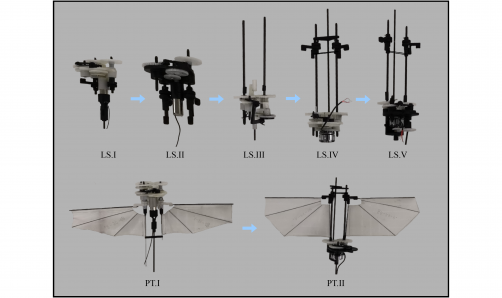
The study, titled “Lift System Optimization for Hover-Capable Flapping Wing Micro Air Vehicle“, introduces a novel system inspired by the mechanics of hummingbirds. By integrating elastic energy storage elements at the wing root, the researchers have successfully mimicked the natural muscle and bone structure of these birds, allowing for efficient energy storage and release during flight. The resulting mechanism achieves an impressive flapping angle of 154°, optimizing flight dynamics.
With a wingspan of 175 mm and a total weight of just 10.5 g, the new prototype can generate a stable lift of 31.98 g, which is a remarkable 17.6% of its own weight. This achievement marks a significant advancement in the field, showcasing enhanced aerodynamic efficiency and reliability. Furthermore, the design has achieved a 30.4% reduction in fuselage weight—dropping from 2.3 g to 1.6 g—while maintaining structural integrity and preventing resonance.
The researchers conducted extensive tests on various wing parameters, including materials and design layouts, leading to the development of an optimized wing named 80-455. Using materials such as 8000 Resin and 7500 Nylon, the team has also reduced power consumption by 4.5% under similar lift conditions, making this lift system not only powerful but also energy-efficient.
Flight tests confirmed that the prototype can hover continuously for about 1 minute at 50% throttle, while also executing agile maneuvers like rapid ascent. This breakthrough is expected to have a profound impact on various industries, as it addresses long-standing challenges in drone technology.
The research paper, authored by Shengjie XIAO and colleagues, highlights the importance of bridging gaps in materials, energy, and design systems to drive the future of micro air vehicles. The full text is accessible at https://doi.org/10.1007/s11465-024-0790-6.
WHAT’S NEXT: As this technology advances, expect further developments in drone capabilities that could revolutionize transport, surveillance, and even personal use. The implications of this research extend beyond academia and could soon lead to practical applications that enhance our everyday lives. Stay tuned for more updates on this exciting frontier in drone technology.