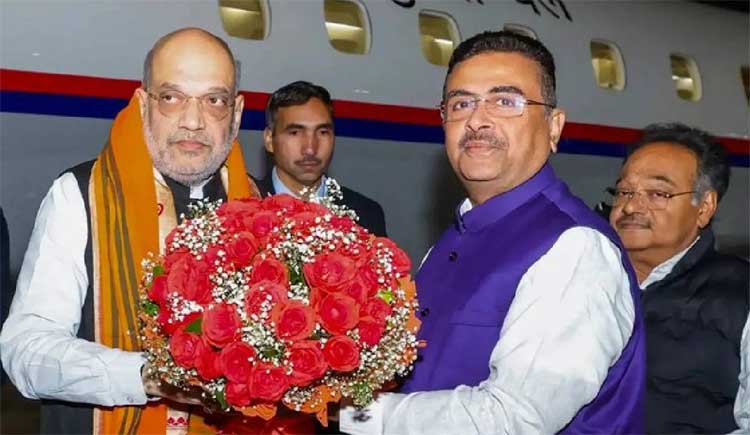
Amit Shah Arrives in Kolkata for Crucial BJP Meeting to Name Bengal Chief Minister
Amit Shah landed in Kolkata on Friday for a decisive Bharatiya Janata Party meeting to choose its first chief minister in West Bengal following a historic Assembly election victory. Shah, appointed as the BJP’s central observer for the legislative party leader election, will oversee the critical decision as the party prepares to form its inaugural government in the state.
The BJP team is racing against time to finalize its chief ministerial candidate from leading contenders Suvendu Adhikari and Agnimitra Paul. This meeting comes just a day after the state legislative assembly was formally dissolved by West Bengal Governor R N Ravi, ending the five-year term amid a charged political atmosphere.
Political Tensions Surge After BJP Landslide Amid Violent Attack on Suvendu Adhikari’s Aide
Political tensions in Bengal have sharply escalated with the murder of Chandranath Rath, a close aide to BJP leader Suvendu Adhikari. Rath was gunned down late Wednesday night by bike-riding attackers in Madhyamgram. He sustained fatal bullet wounds to the head, chest, and abdomen and was declared dead after hospital admission. His body was later transported to his hometown in Purba Medinipur as police continue their investigation.
Authorities have recovered the motorcycle linked to the shooting, and the vehicle is held at the Madhyamgram police station as part of ongoing probes. This killing adds to the urgency of the BJP’s leadership decision amid an increasingly volatile political climate ahead of government formation.
Assembly Dissolved After BJP’s Historic Victory Over Trinamool Congress
The West Bengal legislative assembly was dissolved on Thursday by Governor R N Ravi following the BJP’s overwhelming victory in the 294-seat House. The BJP secured a commanding 207 seats, marking the first time the party will govern West Bengal. The ruling Trinamool Congress (TMC) was relegated to 80 seats, a devastating blow to outgoing Chief Minister Mamata Banerjee, who refused to formally resign, sparking a political standoff.
Banerjee lost the high-profile Bhabanipur constituency to Suvendu Adhikari by over 15,000 votes, a key factor in the BJP’s historic win. The refusal to quit has raised questions over the transition of power and added pressure on law enforcement and state administration.
BJP Names Observers to Oversee Legislative Party Leader Election
Alongside Amit Shah, the BJP has appointed Mohan Charan Majhi as co-observer to supervise the election of the party’s legislative leader in Bengal. This step signals the BJP’s intent to expedite the appointment of a chief minister, projecting unity and control after the election triumph.
The outcome of this leadership vote is expected imminently, defining the direction for West Bengal’s first BJP-led government. For the United States and Delaware audiences, this marks a significant political shift in Indian democracy, reflecting the deep regional impacts of national politics under Prime Minister Narendra Modi. Modi’s victory in Bengal is notable as he becomes the first sitting prime minister since Jawaharlal Nehru to lead his party to a win in this key eastern state.
What’s Next: Power Shift and Stability Concerns in West Bengal
All eyes are now on Amit Shah’s meeting and the BJP’s internal voting as West Bengal grapples with political violence and uncertainty. The murder of a key BJP worker raises immediate safety concerns ahead of government formation. Meanwhile, Mamata Banerjee’s refusal to accept defeat heightens fears of prolonged instability.
The BJP’s leadership choice will determine the state’s political landscape and could influence broader national politics as India’s largest opposition party continues to expand its footprint. International observers, including political watchers in the United States, are closely monitoring the unfolding developments and the BJP’s ability to establish governance amid a tense transition.
Stay tuned to The Delaware Herald for continuous updates on this breaking story.