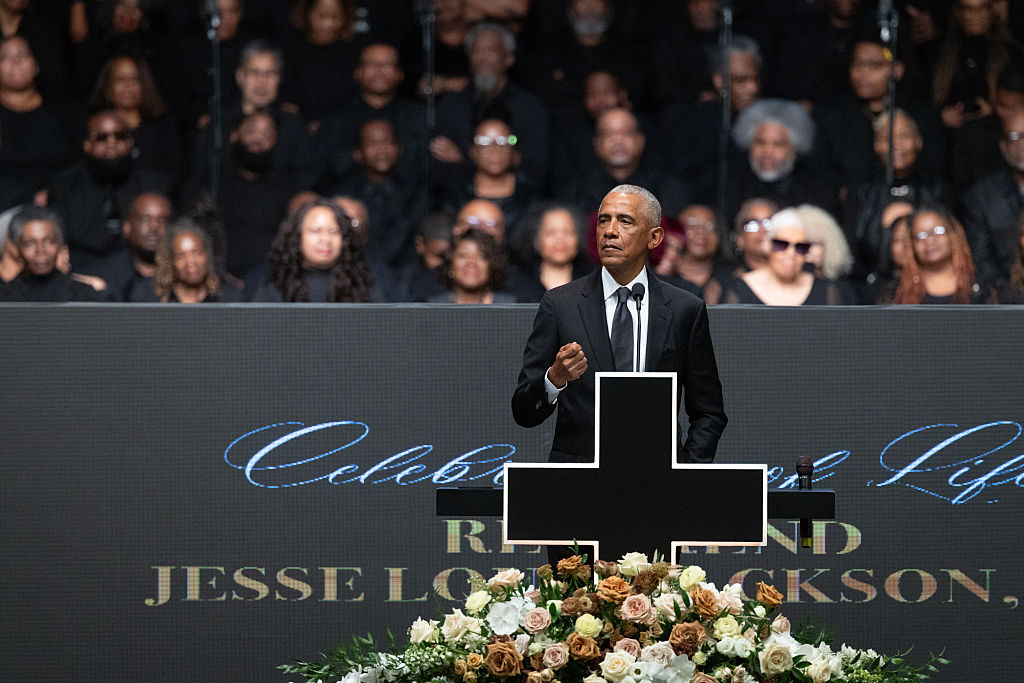
Thousands of attendees gathered on March 15, 2024, in Chicago to honor the life and legacy of civil rights leader Jesse Jackson, who passed away last month at the age of 84. The memorial service featured a remarkable lineup of political leaders, activists, and public figures, all recognizing Jackson as a transformative force in American politics and the modern civil rights movement.
Among the distinguished attendees were former presidents Barack Obama, Joe Biden, and Bill Clinton, as well as former vice president Kamala Harris and former secretary of state Hillary Clinton. They were joined by civil rights leaders, elected officials, and thousands of mourners who came to commemorate Jackson’s lifelong fight for racial equality, voting rights, and economic justice.
Jackson gained national prominence as a protégé of Martin Luther King Jr. before establishing his own influential civil rights campaigns. He notably made two historic presidential runs in 1984 and 1988. His work was instrumental in creating the “Rainbow Coalition,” a political movement aimed at uniting marginalized communities and enhancing political participation across the United States.
The service took place at a large church on Chicago’s South Side, where attendees were treated to speeches, music, and personal tributes that captured Jackson’s profound influence on generations of political leaders and activists.
Obama, delivering one of the most poignant tributes, credited Jackson’s activism as a source of inspiration for his own political journey. He urged Americans to continue Jackson’s mission of promoting unity and justice. “Each day we’re told to fear each other,” Obama remarked, cautioning against divisive political forces that threaten democratic values. He encouraged the audience to follow Jackson’s example and “step up” to contribute to a more equitable society.
Other speakers echoed similar sentiments. Biden praised Jackson’s unwavering determination and dedication to social justice, while Clinton reflected on Jackson’s role in pushing political leaders to confront inequality and broaden opportunities for disadvantaged communities.
Civil rights leaders highlighted Jackson’s global impact and grassroots organizing efforts. Throughout his career, he championed voting rights, education access, and economic opportunity, often traveling internationally to advocate for human rights and engage in political negotiations.
By the end of the ceremony, speakers framed Jackson’s legacy as one deeply rooted in coalition-building and political engagement, rather than solely in protest. As mourners celebrated his life, many emphasized that the causes Jackson championed—ranging from voting rights to economic equality—are still pressing issues in contemporary American politics.