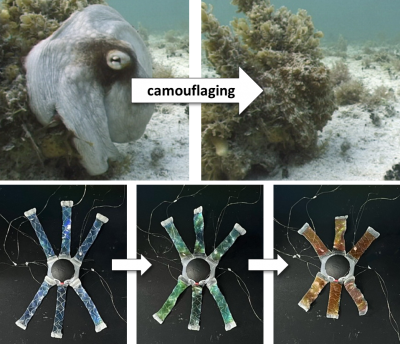
A research team led by Dr. Dae-Yoon Kim at the Korea Institute of Science and Technology (KIST) has introduced a groundbreaking soft robot named OCTOID. This innovative creation mimics the remarkable camouflage and agile movements of octopuses. The robot not only changes its color and shape but also adapts its movements to blend seamlessly with its environment, offering potential applications in various fields.
The Functional Composite Materials Research Center at KIST, under the leadership of Sangrok Oh, has been the driving force behind this project. The team designed OCTOID to respond to electrical stimulation, allowing it to change color dynamically. This feature is not merely aesthetic; it plays a crucial role in the robot’s ability to adapt its appearance and functionality based on its surroundings.
OCTOID distinguishes itself from traditional soft robots by integrating multiple functionalities. It can bend, stretch, and grasp objects, making it an advanced prototype for future robotics. This versatility opens doors to potential applications in fields such as healthcare, where robots could assist in surgeries or rehabilitation, and in environmental monitoring, where they could navigate through various terrains while remaining inconspicuous.
Technological Innovations and Future Applications
The development of OCTOID reflects significant advancements in robotics and materials science. The robot employs a soft, flexible structure that mimics the complex movements of an octopus, enabling it to perform tasks that require dexterity and precision. The color-changing ability is achieved through a novel mechanism that utilizes electrical signals to stimulate the materials, allowing for real-time adjustments.
This research not only showcases the potential of soft robotics but also highlights the importance of biomimicry in technological innovation. By studying the natural adaptations of octopuses, the KIST team has created a robot that can potentially revolutionize how machines interact with their environments.
As the project progresses, the researchers aim to refine OCTOID’s capabilities further. Future iterations may include enhanced sensory feedback systems, allowing the robot to respond more intuitively to its surroundings. Additionally, the team is exploring the possibility of using OCTOID in more complex environments, such as underwater exploration or disaster response scenarios.
The implications of this research extend beyond academic curiosity. With the global robotics market projected to reach over $100 billion by 2025, innovations like OCTOID could position South Korea as a leader in this rapidly evolving field. The ability to create robots that can adapt and respond like living organisms will likely attract interest from industries seeking to integrate advanced automation solutions.
In conclusion, the development of OCTOID by Dr. Kim and his team at KIST represents a significant step forward in soft robotics. Its ability to change color and movement dynamically opens up a realm of possibilities for future applications. As research continues, OCTOID may soon find its place in various sectors, combining functionality with the elegance of nature’s designs.