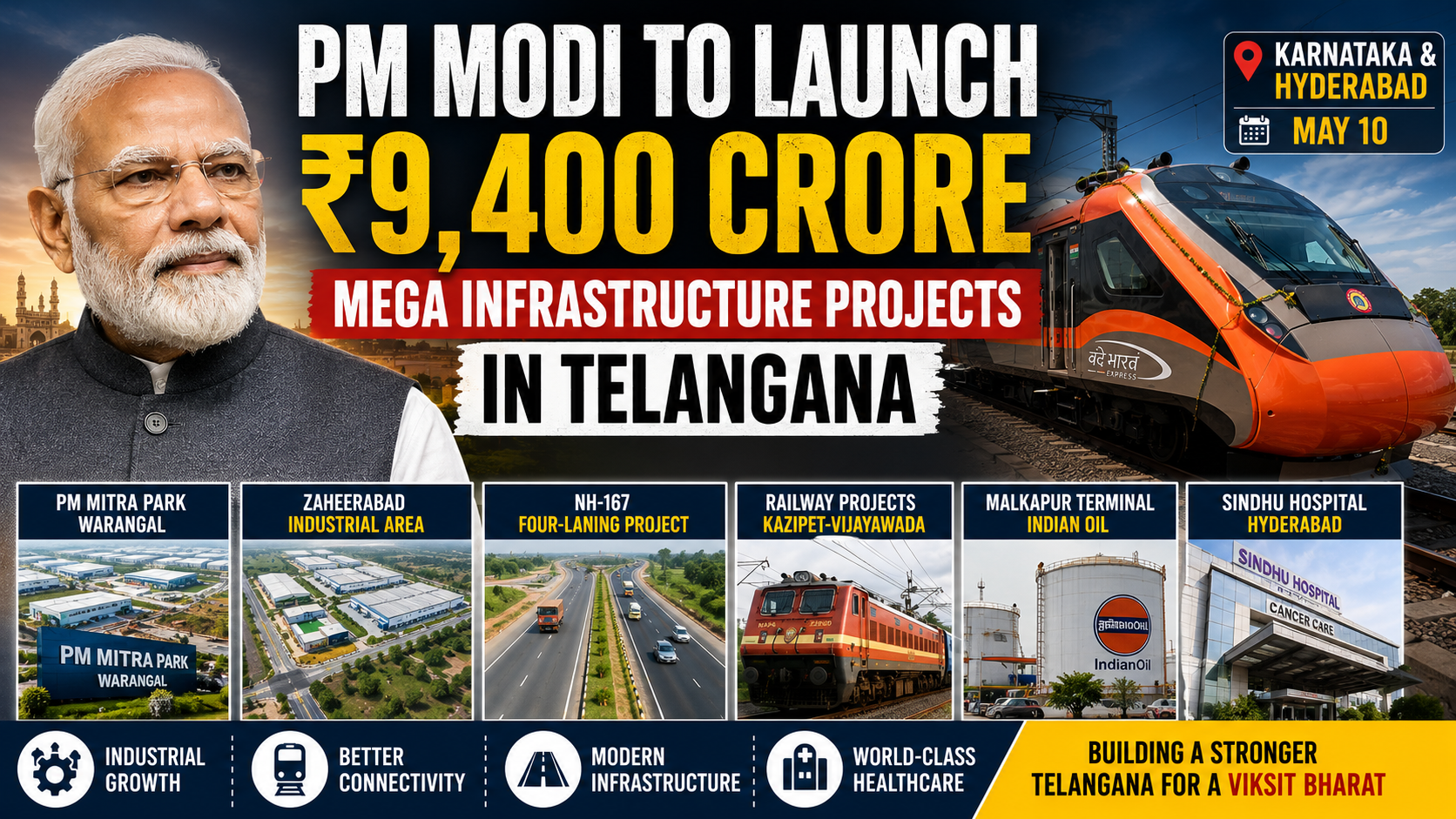
Prime Minister Narendra Modi launched a staggering ₹9,400 crore wave of transformative infrastructure and industrial projects across Telangana and Karnataka today, accelerating the region’s growth trajectory and setting a new benchmark for development in India’s southern hubs.
Modi’s action-packed visit included high-profile programs in Bengaluru and Hyderabad, starting at 11 AM in Bengaluru with celebrations marking the 45th anniversary of The Art of Living and the 70th birthday of Sri Sri Ravi Shankar. Here, Modi inaugurated the newly built Dhyan Mandir meditation hall, symbolizing a focus on spiritual wellness alongside socioeconomic progress.
Following the Bengaluru events, Modi shifted to Hyderabad by 3 PM, where he dedicated and laid foundation stones for a suite of major projects targeting improved connectivity, industrial expansion, and advanced healthcare, collectively valued at nearly ₹9,400 crore.
Major Infrastructure Projects to Revolutionize Telangana
A key highlight was the launch of the four-laning of National Highway-167 from Gudebellur to Mahabubnagar under the Hyderabad–Panaji Economic Corridor, developed at over ₹3,175 crore. Officials project this upgrade will slash travel time by nearly 90 minutes, curb fuel expenses, and fuel economic activity by boosting logistics and passenger convenience.
Modi also laid the foundation stone for the sprawling Zaheerabad Industrial Area—spanning 3,245 acres and costing over ₹2,350 crore—situated strategically along NH-65 within the Hyderabad–Nagpur Industrial Corridor. Designed as a smart, integrated township, it is expected to attract investments of nearly ₹10,000 crore and create large-scale jobs in automobile manufacturing, machinery, food processing, electrical equipment, and metals.
The Prime Minister inaugurated the first fully operational PM MITRA Park at Warangal — the Kakatiya Mega Textile Park — developed under the ambitious PM MITRA scheme at about ₹1,700 crore. This project is a bold step to boost India’s textile industry under the government’s “5F” vision, extending from farm to foreign markets and integrating seamless multimodal transport links.
Rail and Energy Boosts to Support Regional Growth
On the railway front, Modi dedicated components of the Kazipet–Vijayawada multi-tracking project, worth around ₹1,535 crore, boosting capacity across 118 kilometers on the Grand Trunk route. The upgrade promises faster, punctual trains and eased congestion for both passengers and freight. Additionally, the Kazipet Rail Under Rail Bypass was dedicated, streamlining train movement towards Hyderabad, Balharshah, and Vijayawada, greatly enhancing operational efficiency.
Energy infrastructure also saw a major boost with the dedication of Indian Oil’s Greenfield Terminal at Malkapur in Hyderabad. Built at a cost of over ₹600 crore, this terminal increases petroleum product handling capacity with 165,000 kilolitres of storage, supporting energy and fuel logistics across Telangana and neighboring states.
Cutting-Edge Healthcare Expansion in Hyderabad
Highlighting healthcare advancements, Modi inaugurated the state-of-the-art Sindhu Hospital, a 1,500-bed multi-specialty cancer care facility spanning 2.1 million square feet in Hyderabad. Equipped with 29 advanced operation theaters and specialized cancer treatment options including chemotherapy, radiation therapy, and bone marrow transplants, the hospital will deliver critical services across 33 super-specialty departments, promising to elevate regional healthcare standards.
Official sources stated the projects underscore the government’s vision for “Viksit Telangana for Viksit Bharat,” aiming for integrated development, industrial growth, enhanced connectivity, and better quality of life.
For residents of Delaware and across the United States, this development signals India’s continued push towards modern infrastructure and healthcare, reflecting a growing global trend of large-scale, sustainable development projects designed to boost economies and regional growth centers.
The ambitious scale and breadth of today’s inaugurations demonstrate India’s drive to emerge as a global industrial and logistics powerhouse, potentially impacting international trade ties and investment flows that resonate worldwide.
As the projects progress, close attention will turn to how these infrastructure enhancements influence regional economic dynamics, employment, and cross-border commerce — key factors of interest for global markets and stakeholders in international development.